Validation Master Plan for GMP Manufacturing: A Practical Guide to Compliance

In today’s pharmaceutical industry, validation is under more scrutiny than ever. Regulators are no longer satisfied with documentation alone. They expect clear evidence that systems, processes, equipment, and data consistently meet quality and safety standards.
Yet despite this shift, many organisations still treat validation as a box-checking exercise, something to complete for audits rather than a strategic capability.
That mindset is changing.
A well-defined validation master plan does more than help you pass inspections. It creates a structured framework for validation activities, strengthens product quality, reduces risk, and improves operational efficiency. In short, it becomes a business advantage.
For companies operating in regulated environments, effective GMP validation planning is essential. It ensures that validation work is not reactive, fragmented, or overly document-heavy, but aligned with quality, compliance, and business objectives from the start.
Why a Validation Strategy Matters
At its core, validation is about confidence: confidence that your systems, equipment, and processes will consistently deliver results that meet predefined requirements.
But when done right, it delivers much more than compliance:
- Reduced regulatory risk through alignment with global expectations, including FDA, EMA, and MHRA requirements
- Improved product quality and process consistency
- Stronger data integrity and traceability
- More efficient use of resources through targeted, risk-based efforts
- Greater audit readiness and stronger inspection readiness GMP confidence
A strong validation strategy pharma organisations can rely on helps ensure that validation is not treated as a standalone activity. Instead, it becomes part of a wider quality and compliance framework that supports long-term operational control.
Organisations that treat validation strategically, not just operationally, are far better equipped to manage change, respond to regulatory expectations, and sustain compliance over time.
From “One-Size-Fits-All” to Risk-Based Validation
Not every system or process carries the same level of risk, and your validation approach should reflect that.
Modern regulatory guidance, especially ICH Q9, emphasises Quality Risk Management. The idea is simple: focus your time and effort where it matters most.
A risk-based validation approach enables you to:
- Prioritise GxP-critical systems and processes
- Concentrate testing on areas with the highest impact on patient safety and product quality
- Avoid unnecessary documentation and over-validation
- Align with industry best practices such as GAMP 5
- Support smarter, more efficient validation decision-making
For example, a manufacturing execution system managing batch records would require extensive validation, while a non-GxP scheduling tool would not demand the same level of scrutiny.
The key is structured system classification and impact assessment. This sets the foundation for everything that follows, from the validation master plan through to testing, reporting, release, and ongoing maintenance.
Adopting a Lifecycle Validation Approach
Validation is no longer a one-time activity completed during implementation. Regulators increasingly expect a lifecycle validation approach, one that ensures systems remain in a validated state throughout their operational life.
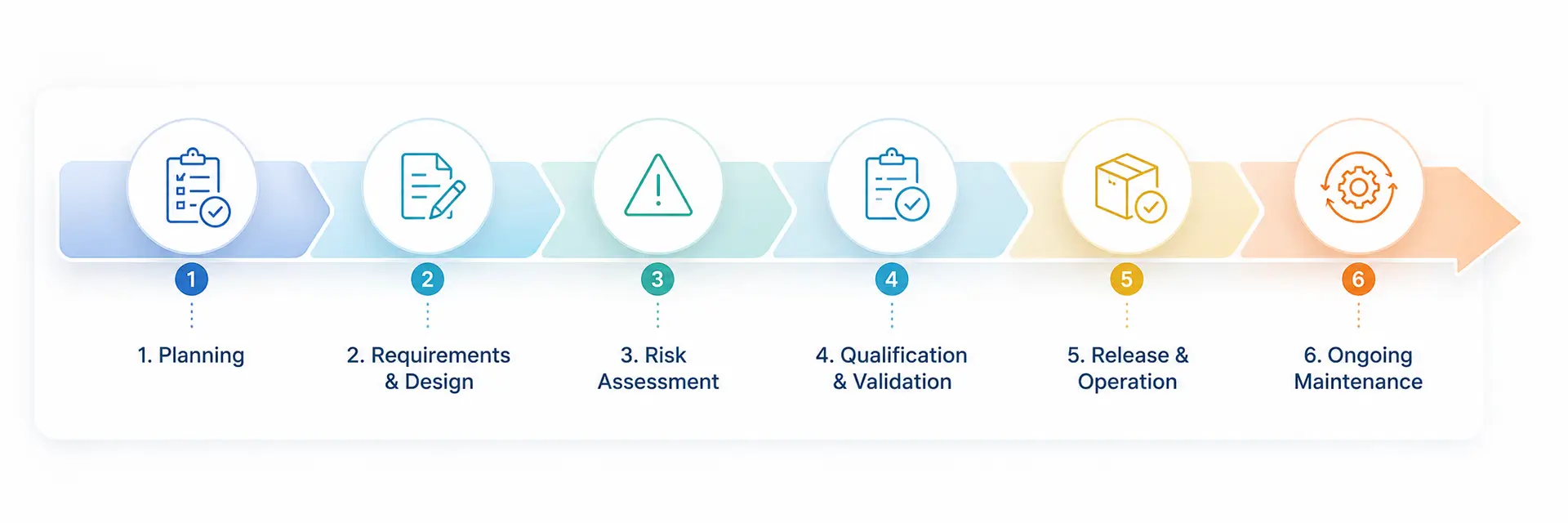
A typical validation lifecycle includes:
1. Planning
Define validation objectives, scope, responsibilities, and deliverables. This is where the validation master plan or project-specific validation plan becomes essential. It provides the structure for how validation will be managed, documented, reviewed, and maintained.
2. Requirements and Design
Develop clear and traceable User Requirements Specifications, Functional Specifications, and Design Specifications. These documents should define what the system or process needs to do and how success will be measured.
3. Risk Assessment
Identify potential risks to product quality, patient safety, and data integrity. Determine appropriate mitigation measures and testing requirements based on risk.
4. Qualification and Validation
Execute qualification and validation activities, including:
- Installation Qualification
- Operational Qualification
- Performance Qualification
Testing should demonstrate that systems perform consistently under expected operating conditions.
5. Release and Operation
Formally approve validated systems for operational use following successful completion of testing, documentation review, and quality approval.
6. Ongoing Maintenance
Maintain validated status through:
- Change control
- Periodic review
- Deviation management
- CAPA activities
- Revalidation where required
This lifecycle validation approach ensures continued compliance, system reliability, and operational confidence over time.
Documentation: Still Critical, But Not the Goal
Documentation remains the backbone of GMP validation, but it should support the process, not drive it.
Effective validation documentation should be:
- Clear and concise
- Traceable from requirements to testing
- Controlled and versioned
- Audit-ready at all times
- Aligned with the overall validation strategy and quality system
Key validation documents typically include:
- Validation Master Plan
- User Requirements Specifications
- Functional and Design Specifications
- Risk Assessments
- Validation Protocols
- Validation Reports
- Traceability Matrices
- Standard Operating Procedures
The focus should be on quality and relevance, not volume. Good documentation should make it easy to understand what was validated, why it was validated, how risk was addressed, and what evidence supports release and continued use.
Ensuring Data Integrity Throughout Validation
Data integrity continues to be a major regulatory focus across the pharmaceutical industry. Validation activities must demonstrate that data generated by GMP systems is complete, accurate, reliable, and attributable throughout its lifecycle.
Organisations should ensure validated systems support:
- Secure user access management
- Audit trail functionality
- Electronic record protection
- Data backup and recovery procedures
- System security controls
- Accurate and reliable data processing
All validation activities should align with ALCOA++ principles, ensuring data remains Attributable, Legible, Contemporaneous, Original, Accurate, Complete, Consistent, Enduring, and Available.
In practice, this means thinking beyond functionality and ensuring systems protect the integrity of critical data at every step.
Validation Governance Framework: Connecting Validation with Quality
Validation cannot operate as a standalone function. Sustainable compliance requires integration with the organisation’s broader Pharmaceutical Quality System.
A clear validation governance framework helps define ownership, responsibilities, approval routes, escalation points, and decision-making processes. This ensures validation activities are controlled, consistent, and aligned with both regulatory expectations and internal quality standards.
Key areas of integration include:
Change Control
Any modification to validated systems, processes, or equipment should be formally assessed to determine validation impact and required actions.
Deviations and CAPA
Validation-related deviations should be investigated thoroughly, with corrective and preventive actions implemented where necessary.
Supplier and Vendor Management
Third-party suppliers play a critical role in maintaining validated systems. Supplier qualification and periodic assessment should be incorporated into validation planning.
Training and Competency
Personnel involved in validation activities must possess appropriate technical knowledge and GMP awareness to perform their responsibilities effectively.
Strong integration between validation and quality systems supports continuous compliance, operational control, and inspection readiness.
Best Practices for a Sustainable Validation Strategy
Organisations looking to elevate their validation approach should focus on a few key principles:
- Establish a clear validation master plan and defined validation ownership
- Apply risk-based decision-making throughout the validation lifecycle
- Maintain traceability between requirements, risks, testing, and outcomes
- Align validation activities with quality management processes
- Build a strong validation governance framework
- Periodically review validation procedures to ensure continued regulatory alignment
- Focus on maintaining validated status rather than treating validation as a one-time exercise
- Ensure GMP validation planning supports both compliance and operational efficiency
A sustainable validation strategy creates a framework that supports quality, regulatory confidence, and long-term business performance.
Building Long-Term Confidence in GMP Validation
An effective validation strategy is not simply about passing inspections. It is about creating confidence that systems, processes, equipment, and products consistently meet the highest standards of quality, safety, and compliance.
A well-structured validation master plan gives organisations the foundation they need to manage validation in a controlled, risk-based, and lifecycle-driven way.
Organisations that embrace a clear validation strategy, strong GMP validation planning, and a lifecycle validation approach are better positioned to:
- Ensure consistent product quality
- Maintain regulatory compliance
- Respond effectively to change
- Strengthen inspection readiness
- Operate more efficiently
In a highly regulated industry, that is not just good practice. It is a competitive advantage.
Strengthen Your Validation Strategy with Dataworks
A strong validation master plan gives your organisation the structure, clarity, and control needed to maintain compliance with confidence.
At Dataworks, we support pharmaceutical and MedTech manufacturers with practical validation expertise across GMP validation planning, computerised system validation, data integrity, and lifecycle validation.
Whether you are preparing for an inspection, reviewing your current validation governance framework, or planning a new system implementation, our team can help you identify gaps, reduce risk, and build a validation approach that supports long-term compliance.
Need support with your validation strategy? Talk to Dataworks about building a practical, risk-based approach to GMP validation.